Monday, November 30, 2009

Lightbulbhead Cometh...

Recently I was moved to play with wire and clay, which I am apt to due whenever those two find their way into my possession. What resulted was a curious little fellow named Lightbulbhead. Being the Christmas season I shall attempt an attempted attempt at being a toymaker and list him for purchase. This dashing chap can be found in Amalthea's Attic, a delightful "boo"tique which is haunted in Mastic Beach:

http://www.amaltheasattic.com/catalog/music-sculpture-plush-lightbulbhead-sculpture-p-937.html


Monday, November 23, 2009

Candy Corn on the Road of Yellow Brick

As most sensible people are aware of, Halloween visited for it's annual haunt not long ago - twenty-three days subsequent, in fact. During that blessed season I am usually moved to create an assortment of leaf-men, or scarecrows, and since this tradition began many years past since the Wednesday before last, scarecrows have been of a particular affinity to me. Of course, the obvious suggestion of being stitched together on a cold, autumnal afternoon being a definite influence upon my emotion, as well as the empathy exhumed by the fondness I have for the brutes, it is of little wonder that among the many wonderful characters in literature I have felt an especial sympathy for the Scarecrow from Oz. This inclination towards fellows of the harvest, and indeed, the many forms of golems in general, thus provoked the illustration below. Again, as with Alice, I tried to include all that was described by the creator of the Oz tales, L.Frank Baum, in the initial book, The Wonderful Wizard of Oz. I did, however, take the slightest of liberties in my interpretation of the scene I selected for subject, which takes place in the third chapter - the "post" impaling the poor fellow's back has been translated to a small, dead tree. I sincerely hope the authour would not be upset by this, for if the respect I have for Baum and his creations were to be raised any higher, it's head would most assuredly meet with the ceiling, causing it much irritation and discomfort. That being said, the admiration I possess for the Scarecrow and the stories themselves I pray will not be questioned, and the little contribution below to the visual aspect of the enchanting Oz mythos I pray as well may please and delight.


The following is an excerpt from Chapter Three, How Dorothy Saved the Scarecrow, from L.Frank Baum's The Wonderful Wizard of Oz -

"Dorothy leaned her chin upon her hand and gazed thoughtfully at the Scarecrow. Its head was a small sack stuffed with straw, with eyes, nose, and mouth painted on it to represent a face. An old, pointed blue hat, that had belonged to some Munchkin, was perched on his head, and the rest of the figure was a blue suit of clothes, worn and faded, which had also been stuffed with straw. On the feet were some old boots with blue tops, such as every man wore in this country, and the figure was raised above the stalks of corn by means of the pole stuck up its back.
While Dorothy was looking earnestly into the queer, painted face of the Scarecrow, she was surprised to see one of the eyes slowly wink at her. She thought she must have been mistaken at first, for none of the scarecrows in Kansas ever wink; but presently the figure nodded its head to her in a friendly way. Then she climbed down from the fence and walked up to it, while Toto ran around the pole and barked."

- L.Frank Baum, from "The Wonderful Wizard of Oz."

Thursday, November 12, 2009

Crocodiles and a Room With No Doors

The other morning after having awakened to the sounds of crocodiles playing draughts outside my window, I had a brief mental image of a room madly askew and confining, and soon set myself to inking it as the back of my eyes had beheld it. As with most attempts to capture a thought on paper, I am certain I have neglected details which inhabited the original reverie, but I whit this is the closest I am able to express. I am not altogether unaware of the piece's suggestion of possibly being a self portrait, though this was not the intent. Sometimes a little truth cannot help but confess itself in the creation of a fabrication, especially if that truth is subject to extroverted behaviour, or is in fact, of a very flamboyant disposition.


Tuesday, October 20, 2009

A Shameless Plug For A Carrollian Shirt

A time past I did an illustration of the Jabberwocky based on the poem of the same name by Lewis Carroll. I was put to the idea of submitting it for consideration of being printed on a T-Shirt. A bit of colour I thought may look attractive for such a proposition, so I added a bit to the black and white piece and settled on what appears below. Apparently, it takes votes from fellow human beings to help with the possibility of printing - thus is expounded this shameless plug.

I would be overjoyed and resoundingly grateful if you, my fellow blog friends, would take a moment betwixt sips of coffee or hops in Hopscotch to visit the design and vote to your liking. I extend my most thankfully thankful thanks -

http://www.threadless.com/submission/236722/Jabberwocky

Friday, October 2, 2009

A Midnight Meeting at Borgo Pass

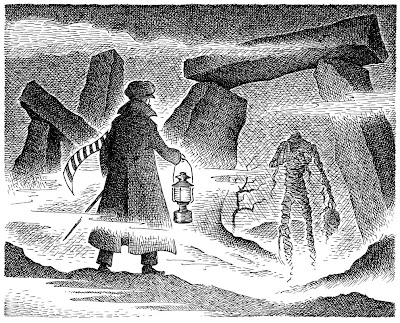
The current month being October I am naturally more sensitive than usual to “ghosts, goblins, and the whole race of witches put together” and, searching for an appropriate subject to examine for an illustration, found myself inevitably gravitating towards one of the single most inspirational characters and stories that began haunting my fascination so long ago I must have entered this world with it already tenanted in my brain. "Dracula," by Bram Stoker, is a listing, beautiful novel with waves of intense horror rising throughout the epistolary narrative like impatient heartbeats and its clout as a classic of gothic literature leaves no mystery as to the reason. There are many captivating examples of the un-dead throughout fiction's history, such as John Polidori’s Lord Ruthven or Varney the Vampire from the infamous Penny Dreadfuls, though none have claimed the superiority that Dracula has silently for over a century. In the story, Stoker's description of Dracula’s appearance suggests something quite grotesque and horrifying as opposed to the suave and aristocratic gentleman Bela Lugosi popularized in Tod Browning’s film version which, as Karloff did for Frankenstein’s monster, gave Count Dracula a face and dialect of iconic significance. I admire both versions of Dracula – the original plague-like monster of Stoker’s masterpiece, as well as the baroque, tuxedoed charmer Lugosi presented on stage and film. The illustration following was done with an effort to flatter the former, and was suggested by a particularly chilling point nearing the end of the first chapter of the novel when the coachman transporting Jonathan Harker entreats him to go on with the others to Bukovina, but was cut short by the arrival of Count Dracula’s caleche…


“…They were driven by a tall man, with a long brown beard and a great black hat, which seemed to hide his face from us. I could only see the gleam of a pair of very bright eyes, which seemed red in the lamplight, as he turned to us.
He said to the driver:
"You are early tonight, my friend." The man stammered in reply:
"The English Herr was in a hurry." To which the stranger replied:
"That is why, I suppose, you wished him to go on to Bukovina. You cannot deceive me, my friend. I know too much, and my horses are swift." As he spoke he smiled, and the lamplight fell on a hard-looking mouth, with very red lips and sharp-looking teeth, as white as ivory. One of my companions whispered to another the line from Burger's "Lenore".

"Denn die Todten reiten Schnell."
("For the dead travel fast.")

The strange driver evidently heard the words, for he looked up with a gleaming smile. The passenger turned his face away, at the same time putting out his two fingers and crossing himself.”

- Bram Stoker

Above this and below the illustration is an excerpt from the novel "Dracula," by Bram Stoker.

Friday, September 18, 2009

The Ghostly Findings of a Ghost-Finder

Halloween is fast approaching and what more appropriate time to visit the mysterious exploits of Thomas Carnacki than when “the leaves are crisped and sere.” The English investigator of things that go bump in the night was created by authour William Hope Hodgson in the early years of last century. The "Ghost-Finder’s” initial appearance in the publications The Idler and The New Magazine coincided with the ever intriguing age of Spirituality which was pockmarked with candle-lit rooms and mournfully adorned individuals of heightened sensitivities to the visits of the deceased and otherwise ethereal passers-by. The Edwardian detective shares similar shades of tone with the brooding Sherlock Holmes, and as a Holmes enthusiast I can honestly expound of my own conviction, Carnacki as most deserving of sharing a hansom cab with the enigmatic gentleman of Baker’s Street. Of the ghosts haunting the pages of Carnackian adventures one may be reminded at times of the dreadful manifestations of H.P. Lovecraft, who was so wonderfully capable of provoking a sense of fear and uncertainty of the unknown foliations and age of existence. The world of spooks is indeed a large one, and its expanse is jealously fogged. Thomas Carnacki, though skeptical until the very last shadow of scientific causation has vanished, is a most intrepid believer compelled to explore this region and his adventures are utterly thrilling. From what I have been able to unearth concerning the literature and publications of Hodgson’s creation have suggested limited illustrations, which only availed my desire to pen my own. The composition of the drawing below was done simply for love of the craft and the stories. Attempting the somber atmosphere of those stories required a tremendous amount of ink and my nose has been greatly piqued by the applications.


Tuesday, September 8, 2009

Immortality and Mayflies

I am recording this only to state a point which not only nettles me, but instigates a curiosity of its impression upon my fellow human beings. I find that more often than not my brain is surprisingly taxed with the knowledge that, as far as I or any living being is aware of, one has but a single lifetime to animate their inspirations and influences. A considerable volume of time that would be best spent sleeping is increasingly becoming exhausted by the contemplation of just this fact, and I daresay every morning I wake up a trifle madder than I had been the previous day. My mortality finds this thoroughly hilarious and spends a great deal of time informing my ambition just how much. The acquisition of lifetimes, like smell-collecting, can be very difficult and best left to Biblical notables though not necessarily people with very large noses, unless they occupy antediluvian earth. Though this does not necessarily impede my thoughts on the subject, and I am afraid it will only strengthen their reserve because they can sometimes be tenacious even when asked not to be. Furthermore, I have just learned that the Dolania americana mayfly exhausts it’s lifespan in a matter of minutes. This bit of knowledge makes me feel very unusual and a bit ashamed for complaining. In any event, I should like several additional lifetimes, or the ability to execute compositional feats at alarming speeds. I hope this is not unreasonable.